
Board Performance · 2025
In this section15 topics
- Compliance Monitoring — Overview1 item
- Prevention of Conflicts of Interest3 items
- Prevention of the Use of Inside Information3 items
- Anti-Corruption4 items
- Whistleblowing3 items
- Selection of Directors & Chief Executives6 items
- Selection of Independent Directors2 items
- Director Development1 item
- Evaluation of Board & Subcommittee Performance2 items
- Subcommittees1 item
- Meeting Attendance & Remuneration5 items
- Supervision of Subsidiaries & Associated Companies5 items
- Board Duty Performance — Overview1 item
- Audit Committee Duty Performance1 item
- Executive Committee Duty Performance1 item
Compliance Monitoring — Overview
Monitoring of Compliance with Other CG Policies & Guidelines
The company places importance on good corporate governance. Relevant policies and practices have been stipulated in the company's corporate governance policy and business ethics. Furthermore, the company promotes genuine implementation to build confidence among all stakeholders.
The company monitors compliance with good corporate governance, including anti-corruption measures. Previously, the Board of Directors oversaw the establishment of an anti-corruption policy and a corruption risk management manual. Additionally, a self-assessment form was provided to build an anti-corruption system. The company was listed as one of the certified members of the Collective Action Coalition of the Thai private sector on December 30, 2022. However, this certification expired on December 30, 2025 (the certification is valid for 3 years). The company will consider submitting an application for renewal of the certification.
Furthermore, risk management policies and plans have been established for executives and employees of the company to utilize in responding to and operating during crises or various events that may result in the organization being unable to operate continuously, or may affect the overall financial performance and operations of the company. This is to ensure that the company can operate continuously and efficiently, reducing the impact of potential damages or losses, and to ensure that operations are efficient and systematic. Additionally, the Risk Management Committee has added a topic on information technology risk management to oversee and ensure that management develops and recognizes concrete risk prevention guidelines.
The company has developed a human rights questionnaire for customers and employees to assess practices that do not violate the human rights of the company's customers and employees. Should any deficiencies be identified, the company will seek practical solutions to prevent and improve them comprehensively.
Additionally, the company has reviewed and revised its sustainability management policy, taking into account alignment with business direction and strategy, under the objective of “leading the organization to sustainable development and profit growth with social and environmental responsibility and good corporate governance.” Further details can be found in Part 1, Section 3: Driving Business for Sustainability.
Prevention of Conflicts of Interest
Has the Company Acted to Prevent Conflicts of Interest?
Yes
Operations in the Past Year
The Board of Directors has established a policy prohibiting directors, executives, and employees from using their positions as directors, executives, or employees of the Company to seek personal gain. This has been set as a policy and guideline within the Company's business ethics, including details for monitoring compliance with such business ethics.
For future related party transactions, directors must comply with established regulations and must not approve any transactions in which they or any other potentially conflicting party have an interest with the Company. Such transactions must be disclosed, and the Company must comply with the Securities and Exchange Act, as well as the regulations, announcements, orders, or requirements of the Stock Exchange of Thailand, including compliance with requirements related to the disclosure of connected transactions and the acquisition or disposal of assets by the Company or its subsidiaries, and strictly adhere to prescribed accounting standards. Furthermore, the Company will not engage in related party transactions with affiliated companies that are not part of the Company's normal course of business and requires directors to report their conflicts of interest at least prior to the consideration of Board of Directors' meeting agendas and record them in the minutes of the Board meeting. In cases where such a director cannot provide an independent opinion, cooperation will be sought from that director to abstain from participating in the meeting and voting on the approval of that agenda item.
During the past year, the Company reviewed the conflict of interest disclosure forms and information on potentially conflicting parties for directors, executives, and controlling persons. It was determined that the content of these disclosure forms now comprehensively collects all relevant information. Directors and executives are required to report their own conflicts of interest and those of potentially conflicting parties to the Company annually.
Regarding the related party transactions of the Company with potentially conflicting parties that occurred during the past year 2025, the Audit Committee reported its opinion to the Board of Directors that the related party transactions were reasonable, fair, and conducted in the ordinary course of business (Fair and at arm’s length), and that the transactions were for the benefit of the Company. Further information can be found under Topic 9: Internal Control and Related Party Transactions. The necessity and reasonableness are summarized as follows:
-
Sales transactions / Purchase products The Company sells particle board furniture to the Index Living Mall Group (which is a group of companies where Mr. Kritschanok Patamasatayasonthi, spouse of Mr. Pacharathanapong Suksawat is a shareholder and authorized director. ) with sales commencing in September 2012. The selling price was determined based on the Company's fair pricing criteria and conducted in the ordinary course of business (Fair and at arm’s length basis). These sales resulted in trade receivables. Additionally, the Company ordered swimming pool cleaning robots from Bottling Co., Ltd., which is a company that Mr. Pacharathanapong Suksawat holds a percentage of shares 60 and is an authorized signatory director. The purchase orders for sale through the Company's online channels are conducted at normal business prices. (Fair and at arm’s length basis) as well
-
Land lease transaction from Mr. Wanlop Suk Sawat has been has been considered and approved for the related party transaction of land lease, and the report of the Audit Committee regarding its opinion on such related party transaction has been acknowledged. On 11 August 2022 previously
-
Director loan transactions and close relatives Director Interest rates are fair and reasonable, serving the Company's benefit due to being lower compared to obtaining loans from financial institutions under agreed terms. jointly
-
Other trade debtors' installment payments and accrued interest The interest rate charged was compared with that of a bank, which is one of the Company's creditors. The collected interest rate does not cause any disadvantage to the Company when compared to other trade debtors requesting installment payments.
Number of Conflict-of-Interest Cases
| Metric | Current Year | Previous Year | Two Years Ago |
|---|---|---|---|
| Total number of cases or issues related to conflicts of interest (cases) | 0 | 0 | 0 |
Prevention of the Use of Inside Information
Has the Company Acted to Prevent the Use of Inside Information?
Yes
Operations in the Past Year
The Company ensures that the use of inside information complies with applicable laws and the corporate governance policy established by the Company. This is achieved through the implementation of a policy for preventing the misuse of confidential information and information that could affect securities prices, issued as the Insider Trading Policy. This policy encompasses directors, executives, employees involved in confidential transactions, and employees of the Company and its subsidiaries, regarding the preservation of confidential and/or inside information of the Company. It prohibits the buying, selling, or receiving of transfers of the Company's securities by utilizing undisclosed confidential or inside information. Furthermore, it prohibits the buying or selling of the Company's securities within specified periods, specifically within 30 days prior to disclosure and not less than 24 hours after such information has been disclosed through the Stock Exchange of Thailand's system. This policy has been communicated throughout the organization to ensure consistent understanding and compliance, through public announcement and requiring written acknowledgment and agreement to adhere to the policy.
As part of establishing good practices, the Company mandates its support unit, specifically the Company Secretary's Office, to regularly send email notifications regarding these practices at least 30 days prior to the Board of Directors' meeting scheduled to certify or approve the Company's financial statements. These notifications are directed to directors, executives, controlling persons, and employees or staff of the Company and its subsidiaries who are presumed to possess or have access to confidential and/or inside information of the Company and its subsidiaries that must be kept confidential.
In the past year, it was not found that the Company's directors and executives engaged in the purchase, sale, or transfer of the Company's securities during the period when such activities were prohibited by the Company. Furthermore, should any transactions involving the purchase, sale, or transfer of securities by directors, executives, their spouses, and minor children occur, the Company Secretary's Office will compile and report these to the Board of Directors' meeting on a quarterly basis.
Number of Inside-Information Cases
| Metric | Current Year | Previous Year | Two Years Ago |
|---|---|---|---|
| Total number of cases or issues related to the use of inside information to seek benefits (cases) | 0 | 0 | 0 |
Anti-Corruption
Has the Company Acted on Anti-Corruption?
Yes
Operations in the Past Year
The company prioritizes improving its internal management processes to ensure transparency and auditability in its operations. We have always believed that conducting business with honesty, integrity, and accountability benefits the company by earning the trust of customers, shareholders, and all stakeholder groups. The company has revised and updated its anti-corruption policy to align with its operational circumstances and has published this policy on its website ( www.eastcoast.co.th ) and publicized it to inform its employees. Furthermore, the company joined the Thai Private Sector Collective Action Against Corruption (CAC) project and was certified on December 30, 2022. However, this certification expired on December 30, 2025 (the certification is valid for 3 years), and the company will consider submitting an application for renewal of the certification.
The company has communicated and publicized its anti-corruption concept to its stakeholders by issuing letters to its business partners and customers, requesting them to refrain from giving/receiving any forms of remuneration, whether cash, goods, or gifts, and prohibiting the giving/receiving of any bribes for the company's business benefits. It also informed them of the process that allows business partners and customers who have not been treated fairly to file complaints and receive remedies. Furthermore, the company has continuously organized meetings, training sessions, and communications to ensure that employees in all departments are aware of this anti-corruption policy and guidelines. In the past, training sessions were conducted to review the said policy and guidelines for all employees at the head office in Klaeng District, Rayong Province. Additionally, all executives and permanent employees of the company have been fully informed and have signed to acknowledge this anti-corruption policy and guidelines.
To establish clear operational guidelines, the company has developed anti-corruption guidelines and a corruption risk management manual, which have been duly considered, approved, and resolved by the Risk Management Committee and the Board of Directors. This policy details duties and responsibilities, measures for establishing a control environment, corruption risk assessment, whistleblowing mechanisms, penalties and remedies, and the review and improvement of the risk management manual, among others.
The company has established guidelines for receiving complaints, as well as for reporting tips on misconduct or acts indicative of impropriety and corruption by the company's personnel to relevant parties and the company, which could cause damage to the company.
Directors, executives, and employees at all levels of the company must not neglect or ignore any acts that constitute corruption involving the company. They must inform their supervisors or responsible persons and cooperate in the inspection, investigation, and inquiry into various facts. Furthermore, the company has established channels for receiving complaints from external parties.
The company will ensure fairness and protection for employees who refuse to engage in corruption or report corruption. The company will not demote, punish, or impose negative consequences on employees who refuse corruption. Furthermore, the company will maintain the confidentiality of all parties involved in the investigation of corrupt acts.
In the past year 2025, the company conducted a corruption risk assessment. The assessment found no corruption risks that would be classified as material risks to the business. The company has established guidelines for various internal control systems, including information systems, document preparation systems with checks and balances, and operational processes to ensure supervision and control for prevention. Furthermore, the company has monitored previously identified corruption risks or analyzed risks with a tendency towards corruption, and the evaluation found that internal controls are still adequate. In the past year, no significant complaints regarding corrupt behavior from the company's directors, executives, or employees have been found within the organization.
Form of Anti-Corruption Operations
| Operation |
|---|
| Review of appropriateness in anti-corruption |
| The participation in anti-corruption projects |
| Assessment and identification of corruption risk |
| Communication and training for employees on anti-corruption policy and guidelines |
| The monitoring of the evaluation of compliance with the anti- corruption policy |
| Review of the completeness and adequacy of the process by the Audit Committee or auditor |
Number of Corruption Cases
| Metric | Current Year | Previous Year | Two Years Ago |
|---|---|---|---|
| Total number of cases or issues related to corruption (cases) | 0 | 0 | 0 |
Whistleblowing
Has the Company Implemented Whistleblowing Procedures?
Yes
Operations in the Past Year
The Company has established a Whistleblowing Policy and Procedures ("the Policy") as a tool to enable the Company to receive complaints from both internal employees and external parties regarding corruption, rights violations, or non-compliance with laws, regulations, company rules, and the Company's business ethics, which could potentially damage the Company's assets, image, and reputation. This Policy will be beneficial and may be adjusted to align and suit prevailing circumstances. Furthermore, the Policy has already stipulated protection and fairness policies for stakeholders and employees who report information or provide tips regarding corruption, rights violations, or non-compliance with laws, regulations, company rules, and business ethics.
In the past year 2025, the Company has not received any complaints regarding corruption, rights violations, or non-compliance with laws, regulations, company rules, and business ethics, nor have there been any negative incidents concerning the Company's reputation arising from the management of the Board of Directors or executives. Furthermore, there have been no cases of directors, whether executive or non-executive, or senior executives resigning due to a lack of good corporate governance policies or adequate and appropriate internal control systems. Additionally, there have been no legal disputes concerning labor or business operations with any stakeholders.
Number of Whistleblowing Cases
| Metric | Current Year | Previous Year | Two Years Ago |
|---|---|---|---|
| Total number of cases or issues received through whistleblowing channels (cases) | 0 | 0 | 0 |
Selection of Directors & Chief Executives
Selection — Introduction
Annually, the Nomination Committee, comprising one independent Chairman of the Nomination Committee and two other Nomination Committee members, totaling three members, shall be responsible for selecting the company's directors. This selection process will adhere to the criteria for selecting new directors. Prior to proposing names to the Board of Directors' meeting, the Nomination Committee shall provide its opinion. The proposed candidates must possess full qualifications as stipulated by the Public Limited Company Act B.E. 2535 (1992), announcements of the Securities and Exchange Commission, the Capital Market Supervisory Board, and relevant announcements of the Stock Exchange of Thailand. This includes utilizing the Director Pool database from the Thai Institute of Directors Association (IOD) as supplementary information for the selection of new directors. Furthermore, the proposed candidates must possess knowledge, capability, dedication, and skills and experience in managing core businesses, as well as other businesses in which the company has invested significantly. Additionally, the selection of directors must be consistent with the company's business strategies. For instance, in the past, as the company increased its investment in the energy business, the Nomination Committee considered and selected new directors who possess qualifications, experience, and expertise in the energy sector to enhance the overall capabilities of the Board of Directors, or the selection of directors with knowledge, capability, and experience in accounting, finance, and investment to strengthen the Board's structure, among others.
Are Directors Selected Through the Nomination Committee?
Yes
Are Chief Executives Selected Through the Nomination Committee?
Yes
Number of Directors from Major Shareholders
3
Rights of Minority Shareholders on Director Appointment
The Company issued an invitation for shareholders wishing to nominate individuals deemed suitable for consideration and selection as directors of the Company. The announcement was posted on the Company's website from October 31 to December 31, 2024. However, no shareholder nominated any suitable individual for consideration at this Annual General Meeting of Shareholders.
Method of Director Appointment
| Method |
|---|
| Method whereby each director requires approval votes more than half of the votes of attending shareholders with voting rights |
Selection of Independent Directors
Criteria for Selecting Independent Directors
The company's independent directors / audit committee members must be directors of the company appointed by the Board of Directors and approved by the company's shareholders, and must possess qualifications as stipulated by securities and stock exchange laws, including notifications, regulations, and/or rules of the Stock Exchange of Thailand. There must be no fewer than 3 such directors. At least 1 audit committee member must have knowledge in accounting and finance, and also possess the qualifications of an independent director as defined by the company's independent director definition. Independent directors with the aforementioned qualifications may be assigned by the company's Board of Directors to make decisions regarding the operations of the company, its major company, subsidiary, associated company, same-level subsidiary, major shareholder, or controlling person, provided that such decisions are made in a collective manner (Collective Decision).
Qualifications of Audit Committee Members
-
Appointed by the Board of Directors or the shareholders' meeting of the company to be an audit committee member.
-
Qualify as an independent director according to the criteria set by the SEC Office and the company's own appropriate and suitable criteria.
-
Not be a director assigned by the Board of Directors to make decisions regarding the operations of the company, its major company, subsidiary, associated company, same-level subsidiary, major shareholder, or controlling person of the company.
-
Not be a director of a major company, subsidiary, or same-level subsidiary, specifically those that are listed companies.
-
Consider the term of office for independent directors. If an existing independent director is to be re-appointed for another term, their continuous term of office from the date of their initial appointment as an independent director must not exceed 9 years. The reasonableness and necessity of re-appointing such independent director will be considered.
-
Possess sufficient knowledge and experience to perform duties as an audit committee member. At least one audit committee member must have sufficient knowledge and experience to review the reliability of financial statements.
-
Have duties similar to those specified in the Notification of the Stock Exchange of Thailand regarding the qualifications and scope of operations of the Audit Committee.
Did Any Independent Director Have a Business or Professional Relationship?
No
Director Development
Qualifications for Director Selection
| Qualification | Skill & Expertise |
|---|---|
| Possesses full qualifications as required by law, including rules and regulations stipulated by regulatory bodies, as well as possessing knowledge, capability, dedication, experience, and general management skills, including experience in financial accounting, the wood industry, furniture, and energy, which will benefit the Company's business, and does not hold positions as a director or executive in other businesses that may create a conflict of interest or be in business competition with the Company. | 116 · Description: Home & Office Products · 164 · Description: Strategic Management · 165 · Description: Risk Management · 265 · Description: Governance/ Compliance · 1683 · Description: Business Administration |
Evaluation of Board & Subcommittee Performance
Criteria for Evaluating Board Performance
The Board of Directors has established guidelines for annual performance evaluation. The Board and its sub-committees will evaluate the performance of each committee at least once a year, allowing the Board to collectively consider achievements and issues for improvement and rectification.
The performance evaluation will be conducted for both the board as a whole and individual members, using the board and individual evaluation forms prepared by the Company Secretary's office. The evaluation will cover the Board of Directors, including all sub-committees, with evaluation criteria for both the board as a whole and individual members, based on the main topics used in the evaluation, namely:
1. Evaluation of the Board's structure and qualifications
2. Board Meetings
3. Roles, Duties, and Responsibilities of the Board of Directors
The process for both board and individual evaluations is as follows:
1. Conduct performance evaluations of the Board of Directors, both as a whole and individually, at least once a year.
2. The Company Secretary summarizes and presents the results of the Board of Directors' performance evaluation to the Nomination Committee for consideration of the evaluation results and guidelines for developing and improving operational efficiency.
3. The Nomination Committee presents the results and guidelines for developing and improving the performance of the Board of Directors to the Board of Directors.
Evaluation of Board Performance in the Past Year
Board of Directors' Self-Assessment Report
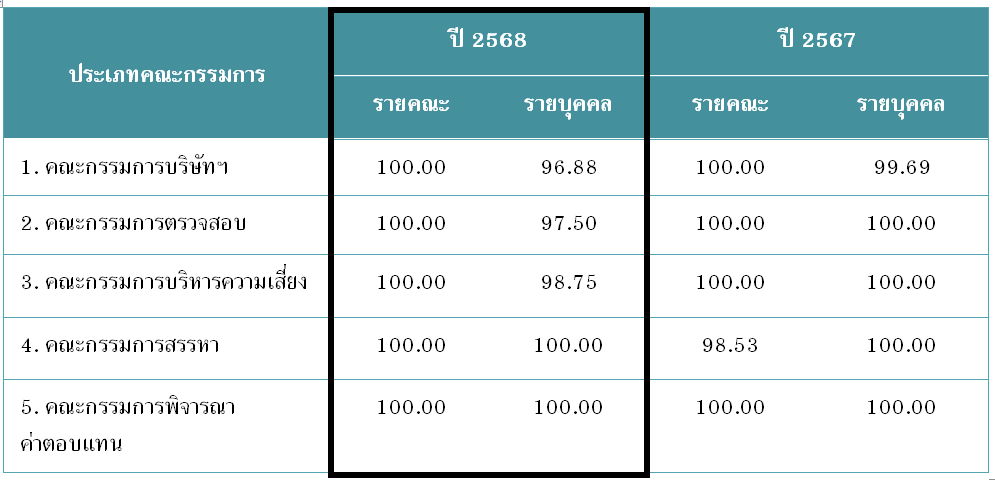
For the year 2025, the average assessment results, out of a perfect score of 100 percent, are as follows:
The meeting considered the data by comparing the assessment results for the years 2024 and 2025. It was found that, overall, the results of the individual assessment forms showed a perfect score of 100 for the Nomination Committee and the Remuneration Committee. Regarding the company's directors, it was observed that some directors scored at level 3 out of a maximum of 4 in all categories.
For the assessment of each committee of the Board of Directors and all sub-committees, all of them achieved a perfect score of 100 percent.
Subcommittees
Subcommittees
| Results of the Subcommittee's Duty Performance | Meetings — Introduction |
|---|---|
The company's Risk Management Committee consists of 4 members who perform their duties in accordance with the Risk Management Committee Charter, comprising: 1. Assoc. Prof. Dr. Montree Sokatiyanurak, Chairman of the Risk Management Committee and Independent Director 2. Assoc. Prof. Songklod Jarusombat, Risk Management Committee Member and Independent Director 3. Mr. Kittipat Suksawad, Risk Management Committee Member 4. Mr. Pacharathanapong Suksawad, Risk Management Committee Member
For the past year 2025, the Risk Management Committee held a total of 2 meetings. In both of these meetings, the Risk Management Committee members attended with a full quorum. Attendees at every meeting, alongside the Risk Management Committee, included the Assistant Managing Director and the Director of Accounting and Finance, who are at the management level, to clarify facts, present risk management results, and provide evidence and progress information for each meeting's presentation.
The meetings of the Risk Management Committee strictly adhered to the Risk Management Committee Charter approved by the Board of Directors. The outcomes of each meeting, including a summary of operations and recommendations deemed beneficial to management, were reported to the Board of Directors. The key points can be summarized as follows: 1. Scope of Authority and Responsibilities of the Risk Management Committee The Risk Management Committee has the following key duties and responsibilities:
2. Meetings of the Risk Management Committee In 2025, the Risk Management Committee held 2 meetings, namely:
Directors attended every meeting with a full quorum, and relevant executives and departments participated to report and provide information for consideration. 3. Performance of the Risk Management Committee in 2025 Over the past year, the Risk Management Committee has overseen and monitored the company's significant risks in various areas, and provided recommendations to management for establishing measures to prevent and mitigate the impact of these risks. The key points can be summarized as follows: 3.1 Operational Risk Management The Committee monitored safety measures in the factory's operations, including the preparation of safety documents and plans, such as:
This includes continuous monitoring of accident statistics and employee training to prevent occupational safety risks. 3.2 Financial and Exchange Rate Risk Management The Committee considered and monitored the company's financial risks, particularly liquidity and exchange rate risks, as the company exports products to foreign countries. The company has implemented measures to reduce risks, such as:
3.3 Production Risk Management The Committee considered risks related to the production process, including:
The company has diversified its raw material sourcing from multiple suppliers, monitors raw material prices, and enters into periodic purchase agreements to control production costs. Additionally, it has developed production technology and automated systems to enhance efficiency and reduce labor-related risks. 3.4 Customer Risk Management The company has implemented measures to diversify its customer base to reduce the risk of over-reliance on any single customer, by expanding export markets to various countries such as India, China, the United States, the Middle East, and the Philippines. For domestic customers, the company verifies information and sets appropriate credit terms to control payment risks. 3.5 Asset and Fire Risk Management The company has arranged insurance covering assets, buildings, machinery, raw materials, and products, as well as third-party liability insurance, to prevent potential damages from unexpected events such as fire or natural disasters. 3.6 Legal and Regulatory Compliance Risk The Committee monitored risks related to compliance with various laws and regulations, with the company implementing key measures such as:
To ensure operations comply with relevant laws and regulations. 3.7 Risk from Investments in Subsidiaries and Associates The Committee closely monitored the operations of subsidiaries and associates by appointing company representatives to serve as directors in the associates and continuously reporting project progress to the Board of Directors. 3.8 Fraud and Corruption Risk The company has strictly implemented an anti-corruption policy, and has been certified by the project CAC (Collective Action Against Corruption) and is in the process of renewing this certification to reaffirm its commitment to transparent and ethical business operations. 3.9 Information Technology (IT) Risk The company has developed an IT system control manual and established appropriate measures for IT system control and supervision, such as:
To ensure that information technology systems are secure and effectively support business operations. 3.10 Environmental and Social Risk The company operates its business with consideration for the environment and society, strictly adhering to environmental laws and conducting environmental quality measurements at its facilities, such as noise levels, lighting, dust, and chemicals. The measurement results are within the prescribed standards. 4. Opinion of the Risk Management Committee The Risk Management Committee is of the opinion that the company has an appropriate and sufficient risk management system, continuously monitoring and assessing the organization's significant risks, and establishing management measures to control risks to an acceptable level, thereby supporting the company in operating its business efficiently and sustainably. | |
The Company's Nomination Committee consists of 3 members, namely: 1) Assoc. Prof. Songklod Jarusombat, Chairman of the Nomination Committee and Independent Director 2) Mr. Kittipat Suksawad, Nomination Committee Member 3) Mr. Patcharathanapong Suksawad, Nomination Committee Member With Assoc. Prof. Songklod Jarusombat serving as the Chairman of the Nomination Committee and an independent director, the Nomination Committee has performed its duties in accordance with its charter and as assigned by the Board of Directors, with prudence, transparency, and fairness. It has also updated its operational guidelines to be comprehensive and aligned with the Company's business policies and strategies, recognizing the best interests of shareholders and stakeholders. In 2025, the Nomination Committee held a total of 3 meetings, during which the following important matters were considered:
Scope of Authority and Responsibilities of the Nomination Committee The Nomination Committee has key duties and responsibilities, including: • Establish criteria and processes for the nomination of directors and senior executives of the Company. • Consider the qualifications, knowledge, competence, and experience of suitable individuals for nomination as directors of the Company. • Consider the composition of the Board of Directors to ensure diversity and suitability for the Company's business operations. • Review the Board Competency Matrix to ensure that the Board of Directors possesses comprehensive skills and experience. • Consider the Executive Succession Planning. • Propose a list of suitable individuals to the Company's Board of Directors and/or the Shareholders' Meeting for consideration and appointment. 2. Nomination Committee Meetings In 2025, the Nomination Committee held regular meetings, with at least 3 meetings convened to consider matters related to director nominations, evaluation of the Board of Directors' composition, and executive succession planning. All directors attended every meeting. 3. Performance of the Nomination Committee in 2025 Over the past year, the Nomination Committee has performed its duties within the scope of its assigned authority, with the key aspects of its operations being as follows: 3.1 Consideration of the Board of Directors' Composition The Nomination Committee has considered the composition of the Board of Directors to ensure its suitability for the Company's business nature. This involved reviewing the Board Competency Matrix to assess the knowledge, competence, and experience of directors in various areas. The evaluation results indicate that the Board of Directors possesses comprehensive knowledge and skills relevant to the Company's business management and is suitable for the Company's corporate governance. 3.2 Nomination and Appointment of Company Directors The Nomination Committee has considered individuals with suitable qualifications and experience for nomination to the Board of Directors, taking into account key factors such as:
3.3 Executive Succession Planning The Nomination Committee has considered guidelines for developing an Executive Succession Plan, taking into account good principles and practices as recommended by the Stock Exchange of Thailand. This process includes:
3.4 Consideration of the Company's Executive Structure The Nomination Committee has considered the Company's executive structure to align with the definition of executives by the Stock Exchange of Thailand, including proposing the appointment of high-potential personnel to executive positions to support the Company's future business operations and growth. 4. Opinion of the Nomination Committee The Nomination Committee believes that the Company has a transparent, fair, and good corporate governance-compliant process for nominating directors and executives. This includes careful consideration of individuals' qualifications and appropriate executive succession planning, to ensure the Company has personnel with the knowledge, competence, and experience suitable for the Company's long-term governance and business operations. | |
The company's Remuneration Committee consists of 3 members, performing duties according to the Remuneration Committee Charter, comprising: 1. Assoc. Prof. Dr. Montree Sokatiyanurak, Chairman of the Remuneration Committee and Independent Director 2. Mr. Kittipat Suksawat, Remuneration Committee Member 3. Mr. Patcharathonpong Suksawat, Remuneration Committee Member
For the past year 2025, the Remuneration Committee held a total of 2 meetings. In both of these meetings, all members of the Remuneration Committee attended the quorum. The meetings of the Remuneration Committee strictly adhered to the Remuneration Committee Charter approved by the Board of Directors. The key aspects can be summarized as follows: The Remuneration Committee is responsible for establishing policies, criteria, and considering the remuneration structure for the company's directors, senior executives, and sub-committees, to ensure it is appropriate and consistent with the company's performance and good corporate governance practices.
| |
During the past year 2025, the Audit Committee performed its duties in the area of corporate governance, with meeting attendance statistics and the number of meetings consistent with those of the Audit Committee. In performing its duties, the Committee adhered to the established charter, scope, authority, and responsibilities in corporate governance. It oversaw the preparation and review of the corporate governance policy, anti-corruption policy, sustainability policy, and related practices, as well as the business ethics code and good corporate governance guidelines, which were submitted to the Company's Board of Directors. The Committee also plans to review relevant policies at least once a year to ensure their continuity and up-to-dateness, as required by relevant regulatory bodies. It oversaw the communication and effective implementation of policies within the organization, and ensured the appointment of appropriate departments or personnel to oversee and monitor the actual implementation of various policies and measures. During the year 2025, the Committee continued to emphasize the review and communication to the Company's directors, executives, and employees for their acknowledgment through written signatures on policy documents and various manuals provided by the Company. Furthermore, it requested that various policies be presented for updates to the Board of Directors' meeting regularly and continuously every year. | Regarding the Company's Corporate Governance Committee, it will have the same structure as the Audit Committee, with separate scope, duties, and responsibilities in the area of corporate governance. |
Meeting Attendance & Remuneration
Meeting Attendance — Sub-section Introduction
The number of directors of the company for the year 2025 was 8. By the Board of Directors meeting held on May 15, 2025, the number of directors had increased to 9. This increase was a result of the resolution approving the appointment of one additional new director at the Annual General Meeting of Shareholders for the year 2025 on April 30, 2025. Subsequently, in January 2026, the most recently appointed new director submitted a letter of resignation from the company. Therefore, the information to be presented will reflect a total of 8 directors of the company.
Justification for Directors' Non-Attendance
Some directors of the company were unable to attend the meeting due to health issues and important engagements.
Types of Remuneration of the Board of Directors
The amount of remuneration for the Company's directors and each sub-committee, incurred in the fiscal year 2025, received from the Company, with no remuneration for directors received from subsidiaries, and independent directors of the Company do not receive any remuneration from the parent company, subsidiaries, or fellow subsidiaries.
The details are as follows:
At the Annual General Meeting of Shareholders for 2025 held on April 30, 2025, a resolution was passed to approve the directors' remuneration for 2025, with details as follows:
1) Monthly remuneration:
-
Chairman of the Board 44,000 Baht per month
-
Director 34,000 Baht per month
-
Chairman of the Audit Committee 39,000 Baht per month
-
Audit Committee Member 34,000 Baht per month
The monthly remuneration rate remains the same as for the fiscal years 2023 and 2024.
2) Meeting allowance for the Board of Directors and all sub-committees: 12,000 Baht per person per meeting (unchanged from 2022 - 2024), comprising the following committees:
-
Board of Directors
-
Audit Committee
-
Risk Management Committee
-
Nomination Committee
-
Remuneration Committee
3) Special remuneration or bonus: Based on performance
4) Other benefits remuneration, including travel expense reimbursement, annual health check-up welfare, health insurance, golf club membership fees, sports club membership (Sport Club) or leisure/recreational club membership (Member Club), and the right to purchase shares or convertible securities for directors or Employee Stock Options (ESOP): -No other benefits-
The meeting has set the total remuneration for directors not exceeding 9,000,000 Baht, which is the same remuneration limit as in the past years from 2018 to 2024.
Note: To ensure good checks and balances and to comply with good corporate governance principles, the Company has established a policy for controlling the remuneration of directors and executives, in addition to the monthly remuneration, meeting allowances, and bonuses specified above, and according to the existing approval authority. Any additional remuneration exceeding 1,000,000 Baht per person per year must be presented as an agenda item to the Audit Committee meeting for consideration and approval, with details and justification for such additional welfare payments.
Remuneration Payable — Introduction
Calculated from the outstanding remuneration for a total of 8 company directors (excluding one director who has already resigned).
Remuneration or Benefits Payable to the Board
| Metric | Amount (Baht) |
|---|---|
| Remunerations or benefits pending payment to the board of directors over the past year (baht) | 1,132,000 |
Supervision of Subsidiaries & Associated Companies
Does the Company Have Subsidiaries or Associated Companies?
Yes
Is There a Mechanism for Overseeing Subsidiaries and Associated Companies?
Yes
Mechanism for Overseeing Management of Subsidiaries
The Company's Board of Directors has governance mechanisms that enable it to control and oversee the management and operational responsibilities of its subsidiaries and joint ventures, which currently total 7 companies, namely:
Subsidiaries
-
VV Decor Co., Ltd., in which the Company holds 99.95% of the shares.
-
ECF Holdings Co., Ltd., in which the Company holds 94.44% of the shares.
-
ECF Power Co., Ltd., in which the Company holds 99.99% of the shares.
-
Planet Board Co., Ltd., in which the Company holds 57.00% of the shares.
-
VV Rich Co., Ltd., in which the Company holds 99.97% of the shares.
-
ECF Design Co., Ltd., in which the Company holds 50.99% of the shares.
Joint Ventures
Green Earth Power (Thailand) Co., Ltd. (GEP), in which ECF Power Co., Ltd., as a subsidiary, holds 20% of the shares.
To safeguard the Company's investment interests, the Company has appointed individuals to represent the Company as directors and executives in the position of Managing Director in subsidiaries, and as directors in joint ventures.
The scope of duties and responsibilities as a director and managing director of a subsidiary will be similar to those of a director and managing director of the Company. The Company's representatives serving as directors in subsidiaries, including joint ventures, will participate in setting important business policies, such as those related to administration and investment.
For subsidiaries numbered 1 to 6, the Company has appointed 3 directors to serve on the boards of a total of 6 subsidiaries. Additionally, for joint ventures, the Company has appointed 1 director to serve on the board.
In the past year, there were no connected transactions of a size requiring approval from the Audit Committee and the Company's Board of Directors.
The Board of Directors has established policies for overseeing the operations of subsidiaries and joint ventures, divided into 3 main parts, namely:
Administrative Governance Policy
Financial Control Policy for Subsidiaries and Joint Ventures
and the Shareholders' Agreement Policy, details as specified in Item 1. Corporate Governance Policy, Principle 3.6 and Guideline 3.6, with details as follows:
The Board of Directors has established policies for overseeing the operations of subsidiaries and joint ventures, divided into 3 main parts, with details as follows:
1. Administrative Governance Policy
-
For the nomination of individuals as directors in subsidiaries and joint ventures, the Company will appoint individuals approved by the Company's Board of Directors' meeting to serve as directors and executives of the subsidiaries and joint ventures, at least in proportion to the Company's shareholding in such subsidiaries and joint ventures. It is stipulated that the nominated directors and executives must possess qualifications, roles, duties, and responsibilities in accordance with relevant laws and regulations.
-
Directors and executives appointed by resolution of the Company's Board of Directors to hold positions in subsidiaries and joint ventures shall have primary duties and responsibilities as determined by the Company's Board of Directors and/or the shareholders' meeting of such subsidiary or joint venture. However, appointed directors and executives must safeguard the Company's interests and ensure compliance with the parent company's policies.
-
The Company's directors must ensure that subsidiaries and joint ventures have appropriate and robust internal control systems to prevent potential fraud within subsidiaries and joint ventures. This includes ensuring that subsidiaries and joint ventures have clear operational systems to demonstrate sufficient mechanisms for continuous and reliable disclosure of significant transactions in accordance with established criteria. Furthermore, there must be channels for the Company's directors and executives to receive information for monitoring and overseeing the performance and financial status, transactions between subsidiaries/joint ventures and their directors/executives, and significant transactions effectively. Additionally, internal control systems must be audited, either by appointing an internal control audit team from the Company or by engaging external internal auditors, and ensuring that the results of internal control audits are regularly reported to the Board of Directors' meetings of the subsidiaries and joint ventures.
-
Directors and executives of subsidiaries must disclose and submit information regarding their interests and those of related persons to the Company's Board of Directors to inform them of relationships and transactions with the Company that may give rise to conflicts of interest. They must avoid transactions that may create conflicts of interest with the Company or its subsidiaries. The Board of Directors of the subsidiary is responsible for informing the Company's Board of Directors of such matters within the timeframe specified by the Company, to serve as information for consideration, decision-making, or approval of any actions. Such consideration will prioritize the overall benefit of the Company and its subsidiaries, as well as compliance with laws, rules, and regulations stipulated by relevant regulatory authorities. Furthermore, directors of subsidiaries must not participate in approving matters in which they have a direct or indirect interest or potential conflict of interest.
-
Transactions between subsidiaries and directors, executives, or individuals who may have a conflict of interest must also consider the criteria for connected transactions as stipulated by regulatory authorities.
-
Directors, executives, or individuals who may have a conflict of interest may conduct transactions with a subsidiary only if such transactions have been approved by the Company's Board of Directors, excluding interested directors, or by the Company's shareholders' meeting, depending on the calculated transaction size (as the case may be). The criteria for calculating transactions as stipulated in the announcements of the Capital Market Supervisory Board and the Stock Exchange of Thailand regarding connected transactions and/or any amended announcements in force at that time shall apply, unless it is a commercial agreement of the same nature that a reasonable person would enter into with a general counterparty under the same circumstances, with commercial bargaining power free from the influence of their status as a director, executive, or related person, as the case may be, and is a commercial agreement approved by the Company's Board of Directors or in accordance with principles already approved by the Company's Board of Directors.
-
Directors, executives, employees, workers, or assignees of subsidiaries and joint ventures, including their spouses or cohabiting partners, and their minor children, are prohibited from using inside information of the Company, its subsidiaries, or joint ventures, whether obtained through their duties or otherwise, that has or may have a significant impact on the Company, its subsidiaries, or joint ventures, or the Company's securities prices, for their own benefit or the benefit of others, whether directly or indirectly, and regardless of whether compensation is received.
-
The Board of Directors of subsidiaries and joint ventures must ensure the disclosure of information regarding other significant transactions, such as capital increases, capital reductions, or the dissolution of subsidiaries, etc., for notification to the Company's Board of Directors' meeting.
2. Financial Control Policy for Subsidiaries and Joint Ventures
-
Subsidiaries and joint ventures are responsible for submitting monthly operating results, reviewed financial statements, and audited financial statements by auditors on a quarterly and annual basis, respectively, as well as data used in the preparation of such financial statements of subsidiaries and joint ventures to the Company, and agree to allow the Company to use such data for the preparation of consolidated financial statements or recognition under the equity method, as the case may be. • Subsidiaries and joint ventures are responsible for preparing budgets for expenses, investments, and operating results, and summarizing comparisons between projected figures for expenses, investments, and operating results and actual figures to the Board of Directors' meetings of the Company, subsidiaries, and joint ventures for acknowledgment, as well as monitoring operating results to align with planned objectives, for reporting to the Company.
-
Subsidiaries and joint ventures are responsible for reporting significant financial issues to the Company upon detection or when requested by the Company to conduct an investigation to determine the cause and report.
3. Policy on Shareholders' Agreements or other similar material agreements
The Company's Board of Directors will ensure the preparation of such agreements in cases of significant joint ventures in other businesses, with voting shareholdings ranging from 20% to not exceeding 50%, to specify clear agreements regarding management authority, participation in important decision-making, and performance monitoring, so that the information can be used for the preparation of the Company's financial statements in accordance with standards and within deadlines.
Oversight Mechanisms
| Mechanism |
|---|
| Sending representatives to act as directors, executives or controlling persons in proportion to shareholdings |
| Defining the scope of powers, duties and responsibilities of directors and executives who represent the company in setting important policies |
| Disclosure of financial information and operating results |
| Transactions between the Company and related persons |
| Other important transactions |
| Acquisition or disposal of assets |
| Internal control system of the subsidiary operating the core business is appropriate and sufficient in the subsidiary operating the core business |
Agreements Between the Company and Shareholders in Managing Subsidiaries
Regarding the investment in joint ventures, namely Green Earth Power (Thailand) Co., Ltd., in which ECF Power Co., Ltd., as a subsidiary, holds a 20% stake in GEP. A shareholders' agreement has been established among the shareholders, with the following key terms and conditions:
1. GEP and GEP-Myanmar have a dividend payment policy at a rate of 90% of net profit after deducting Mandatory Prepayment (MPP) at a rate of 50% and the annual adjusted expenses incurred in that fiscal year.
2. Conditions for share transfer restrictions: Shareholders are prohibited from transferring shares to third parties, unless it is in accordance with the conditions of this agreement.
If a shareholder wishes to transfer shares, they must notify other shareholders first. The shareholder wishing to sell shares must notify other shareholders in writing in advance of their intention to sell shares, and other shareholders have the right to consider purchasing the shares first, according to their proportion or specified conditions. If other shareholders do not exercise their right to purchase,
the seller may then transfer them to a third party. The transferee must not be a person who: conducts business competitive with the company / is involved in illegal activities / lacks financial capability.
3. Reserved Matters requiring approval from directors or shareholders, such as increasing/decreasing registered capital or mergers and acquisitions.
Significant borrowing, investment in new projects, entering into transactions with related parties.
4. Shareholder obligations: Shareholders must not conduct business competitive with the company, must not violate mutually agreed contractual terms, and must provide support for the projects as specified.
5. Default: If a shareholder defaults on the agreement, other shareholders have the right to purchase the defaulting shareholder's shares at a reduced price.
Board Duty Performance — Overview
Board Duty Performance — Overall Description
For the year 2025, at the Board of Directors' Meeting No. 2/2568 on February 27, 2025, a resolution was passed to review the Company's vision, objectives, operational strategies, organizational values, and goals, as detailed in the 2025 Corporate Governance Policy, which remains the same set used in 2022, and the Board's commitment to the 2025 Sustainable Development Goals of East Coast Furnitech Public Company Limited. The Board initiated, participated in the preparation, and provided comments on the policy details, and subsequently issued a written resolution approving the said Corporate Governance Policy. Guidelines were established to ensure compliance with good corporate governance principles according to relevant criteria or practices presented by regulatory bodies (CG Code), aiming to enhance transparency in operations at all levels, including operational staff, management, and the Board of Directors. This serves as a tool to increase potential and competitiveness, foster sustainable growth, and prioritize communities, society, and the environment, which will bring long-term benefits to all stakeholders throughout the business value chain. The Board will continuously review the Company's Corporate Governance Policy to ensure adherence to good corporate governance standards and guidelines.
The Board of Directors' commitment to sustainable development goals includes targets to initiate actions aligned with the Company's context, demonstrating the Company's dedication to sustainable development. This involves the concrete establishment of working groups to implement sustainable development plans in various areas, comprising:
Setting greenhouse gas emission reduction targets
Preparations for data collection and the expected year for data availability.
Energy management methods and water and electricity management methods within the organization.
The initial operational guidelines have been discussed with those responsible for the factory, confirming that concrete actions must be initiated clearly and promptly.
In 2025, the Company reviewed its risk management policy and plan. This was developed to enable the Company's executives and employees to respond to and operate during crises or various events that might disrupt continuous operations or affect the overall performance and operational results of the Company. The aim is to ensure the Company can operate continuously, efficiently, and systematically, reducing potential damage or losses. Additionally, the Risk Management Committee will report to the Board of Directors on the consideration of potential risk factors to the Company's business operations and continuously propose risk prevention guidelines. The Board also considered and reviewed the sustainability management policy and goals, taking into account alignment with business direction and strategies, under the objective. “Leading the organization to sustainable development and profit growth, with social and environmental responsibility and good corporate governance.” To reflect the intention and commitment to drive business with consideration for good corporate governance issues, including environmental and social aspects, which encompass the importance of respecting human rights. This serves as a guideline for operations and to foster understanding among all stakeholders.
The Company places importance on establishing internal control systems at both management and operational levels to ensure efficiency and effectiveness in operations at all levels. At the Board of Directors' Meeting No. 2/2568 on February 27, 2025, with all audit committee members present, the adequacy of the Company's internal control system was assessed based on the internal control adequacy assessment form, covering 5 aspects: Control Environment, Risk Assessment, Control Activities, Information and Communication, and Monitoring Activities.
The objective of the internal control system audit is to promote effective management, internal control, performance reporting, and good corporate governance, thereby increasing transparency and building confidence for shareholders and all stakeholders of the Company. Its scope covers testing and evaluation to obtain reasonable assurance regarding the adequacy and effectiveness of the Company's existing internal control systems, as well as assessing the quality of operations in each system, taking into account potential business risks arising from current business environmental factors.
The Audit Committee is of the opinion that the Company has appropriate and sufficient internal control systems, including matters related to transactions with major shareholders, directors, executives, or persons related to them, as regularly and continuously approved in accordance with the accounting period. The presentations made by management at the Audit Committee meetings were deemed appropriate and sufficient for the Company's business operations.
Audit Committee Duty Performance
Results of the Audit Committee's Duty Performance in the Past Year
The Company's Audit Committee comprises 3 independent directors who possess knowledge, capabilities, specialized experience, and fully meet the qualifications required by the Stock Exchange of Thailand. They maintain independence in performing their duties according to the Audit Committee Charter.
Comprising:
Assoc. Prof. Dr. Montree Sokatiyanurak, Chairman of the Audit Committee
General Teerdsak Marom, Audit Committee Member
Assoc. Prof. Songklod Jarusombat, Audit Committee Member
For the past fiscal year 2025, the Audit Committee held a total of 4 meetings. In all 4 meetings, the Audit Committee members attended with a full quorum. Attendees at every meeting, alongside the Audit Committee, included certified public accountants and internal control system auditors, who presented facts, audit results, and provided supporting evidence and information for quarterly presentations. On certain significant issues, the Audit Committee invited the Company's executives to attend meetings to provide clarifications on relevant matters. The Audit Committee meetings strictly adhered to the Audit Committee Charter approved by the Board of Directors. The results of each meeting, including a summary of operations and recommendations deemed beneficial to management, were reported to the Board of Directors for their acknowledgment. The key points can be summarized as follows:
Review of quarterly financial statements and the annual financial statements for 2025 before submission to the Board of Directors, to ensure that the financial reports and accounting entries of the Company and its subsidiaries are prepared correctly in accordance with accounting standards and legal requirements. Information is fully and adequately disclosed in the notes to the financial statements, including consideration of financial statement analysis on significant quarterly and annual issues to ensure that the financial statement preparation process and disclosure of important information are accurate, reliable, and in accordance with generally accepted accounting principles. The Audit Committee is of the opinion that the Company's financial reports have been prepared in accordance with generally accepted accounting principles, are accurate as they should be, and reliable, and the selection of accounting policies is reasonable.
For the fiscal year 2025, the Chairman of the Audit Committee urged management to closely monitor progress and implement improvements based on the auditor's observations, and to expedite finding solutions and preventive measures. Details are provided under the following headings:
Investment in GEP, where the second phase of construction has not yet been completed, while the share of profit from the investment is gradually decreasing due to increasing expenses of GEP.
Delay in preparing financial statement information. The Company is urged to expedite planning for problem resolution and preparation, both in terms of data planning and personnel readiness.
Operational Status and Business Continuity
The Group and the Company incurred losses in 2024, continuing into 2025, and have current liabilities exceeding current assets, leading to uncertainty regarding business continuity.Deposit for Power Plant (SAGA) Project Study
The 100 million Baht deposit for the canceled investment has been contracted for repayment in installments with 7.15% interest and classified as other receivables, both current and non-current.Loans to other individuals
Unsecured loans totaling 40 million Baht. Collection should be expedited to quickly increase the Company's liquidity.Inventory and Inventory Management
The Company has a large amount of inventory, some of which is deteriorated or unsaleable, leading to an increase in the allowance for inventory devaluation. It is requested that management approaches be expedited.Loans from financial institutions
The Company has total loans of approximately 800 million Baht, with some portions maturing within 1 year, resulting in tight liquidity. This also necessitates considering the maintenance of DSCR and Current Ratio conditions with various financial institutions.Loans from other individuals and related parties
To address liquidity issues, the Company has borrowed from several individuals and related parties at interest rates ranging from approximately 5–15%.Debentures and Capital Increase Plan
Debentures maturing within one year, approximately 900 million Baht. Management should urgently seek ways to secure funding sources to repay the debt according to payment terms and prevent default.
In the fiscal year 2025, the Board of Directors reviewed the Audit Committee Charter, and no amendments were made during this year.
Review of compliance with securities and exchange laws, regulations of the Stock Exchange of Thailand, and laws related to the Company's business. The Audit Committee is of the opinion that the Company has complied with all relevant laws correctly and completely.
Review of connected transactions or transactions that may have conflicts of interest. The Audit Committee is of the opinion that the inter-company transactions that occurred were reasonable, fair, and conducted in the ordinary course of business (Fair and at arm’s length), as well as being for the benefit of the Company, in accordance with the criteria and regulations of the SEC, the Stock Exchange of Thailand, and have been fully disclosed in the notes to the financial statements.
Review of risk management, audit results reports, and assessment of risk control systems, as well as exchange of views with senior management. The Company will hold meetings to consider potential business risks at least twice a year. In 2025, two joint meetings were held at the level of the Risk Management Committee. In the past year, the Audit Committee considered that the Company's risk management system could significantly impact the Company's operating results, particularly regarding liquidity issues, high debt burden, and high financial costs. Therefore, the Company is requested to plan for managing liquidity problems, reducing debt burden, and lowering financial costs as soon as possible.
In considering the selection of auditors, the performance of the auditors over the past year was reviewed, taking into account their independence, reputation, reliability, ability to review, audit, and certify financial statements, which has consistently been completed on time. The Audit Committee approved proposing to the Board of Directors to seek approval from the Annual General Meeting of Shareholders for 2025 to appoint Mr. Methee Rattanasrimetha (Registration No. 3425) or Ms. Manthana Supanurak (Registration No. 4151) or Ms. Korntip Wanichwisetkul (Registration No. 6947) or another suitable auditor from M.R. & Associates Co., Ltd., should the aforementioned three individuals be unable to perform their duties as required, as the auditors for the Company and its subsidiaries for the fiscal year 2025, and to set the auditor's remuneration at no more than 3,140,000 Baht per year.
For the fiscal year 2025, the Audit Committee is of the overall opinion that it has performed its duties in accordance with the Audit Committee Charter adequately and completely.
Regarding the scope, authority, and responsibilities in corporate governance
For the past fiscal year 2025, the Audit Committee performed its duties in corporate governance, with meeting attendance statistics and the number of meetings consistent with the Audit Committee's meetings.
In performing their duties, they adhere to the charter defining the scope, authority, and responsibilities in corporate governance. They oversee the preparation and review of corporate governance policies, anti-corruption policies, sustainability policies, and related practices, as well as the code of business conduct and good corporate governance guidelines, which are proposed to the Board of Directors. There is a plan to review relevant policies at least once a year to ensure continuity and up-to-dateness, as required by relevant regulatory bodies. They oversee the communication and implementation of policies within the organization, and ensure the appointment of appropriate departments or personnel to supervise and monitor the actual application of policies and measures.
For the fiscal year 2025, the Committee continues to emphasize the review and communication to directors, executives, and employees of the Company for acknowledgment through written signatures on policy documents and various manuals provided by the Company. It also requests that various policies be presented for updated information to the Board of Directors' meetings regularly every year.
Executive Committee Duty Performance
Results of the Executive Committee's Duty Performance in the Past Year
Summary Report on the Performance of the Executive Committee for the Year 2025
Throughout 2025, the Executive Committee closely supervised and monitored the company's operations. Regular meetings were held to consider approaches for managing the company's financial situation, as well as to define measures and strategies for resolving liquidity issues and strengthening the company's business stability. The key aspects of its operations can be summarized as follows:
-
Debt restructuring management and negotiation with financial institutions
The Executive Committee monitored and established guidelines for negotiations with several financial institutions from which the company is currently seeking financial support. This was done to find ways to restructure debt, extend debt repayment periods, and secure new funding sources to support the company's liquidity. Furthermore, the meeting also considered approaches for negotiating with other financial institutions to increase options for managing debt obligations and enhancing the company's financial flexibility.
2. Collateral valuation and utilization of assets in financial negotiations
The Executive Committee monitored the valuation of assets used as collateral with financial institutions to obtain clear information for negotiating debt repayment methods, as well as to serve as crucial data for planning refinancing strategies with other banks and considering the possibility of reducing the company's debt burden.
3. Preparation and review of financial forecasts
The Executive Committee continuously monitored and considered adjustments to the company's financial forecasts to reflect the actual business situation. This included preparing various forms of cash flow projections, both base case and adjusted performance scenarios, to support strategic decision-making and negotiations with financial institutions.
4. Fundraising and issuance of financial instruments
The Executive Committee monitored the progress of the company's financial instrument issuance, such as convertible debentures, including preparations for Board of Directors' meetings and Shareholders' meetings to consider capital increases and the exercise of conversion rights for convertible debentures, in order to enhance liquidity and support the company's long-term business operations.
5. Defining strategies to enhance the company's liquidity
The Executive Committee considered several strategies to maintain the company's liquidity, such as:
• Extending debt repayment periods
• Increasing working capital sources
• Generating additional revenue from core businesses
• Accumulating cash flow to support future financial obligations
These actions are intended to enable the company to continue its business operations more continuously and stably.
In 2025, the Executive Committee closely performed its duties in overseeing the financial and operational management of the company, focusing on resolving liquidity issues, negotiating with financial institutions, and planning financial structures to strengthen the company's long-term stability and sustainability.